

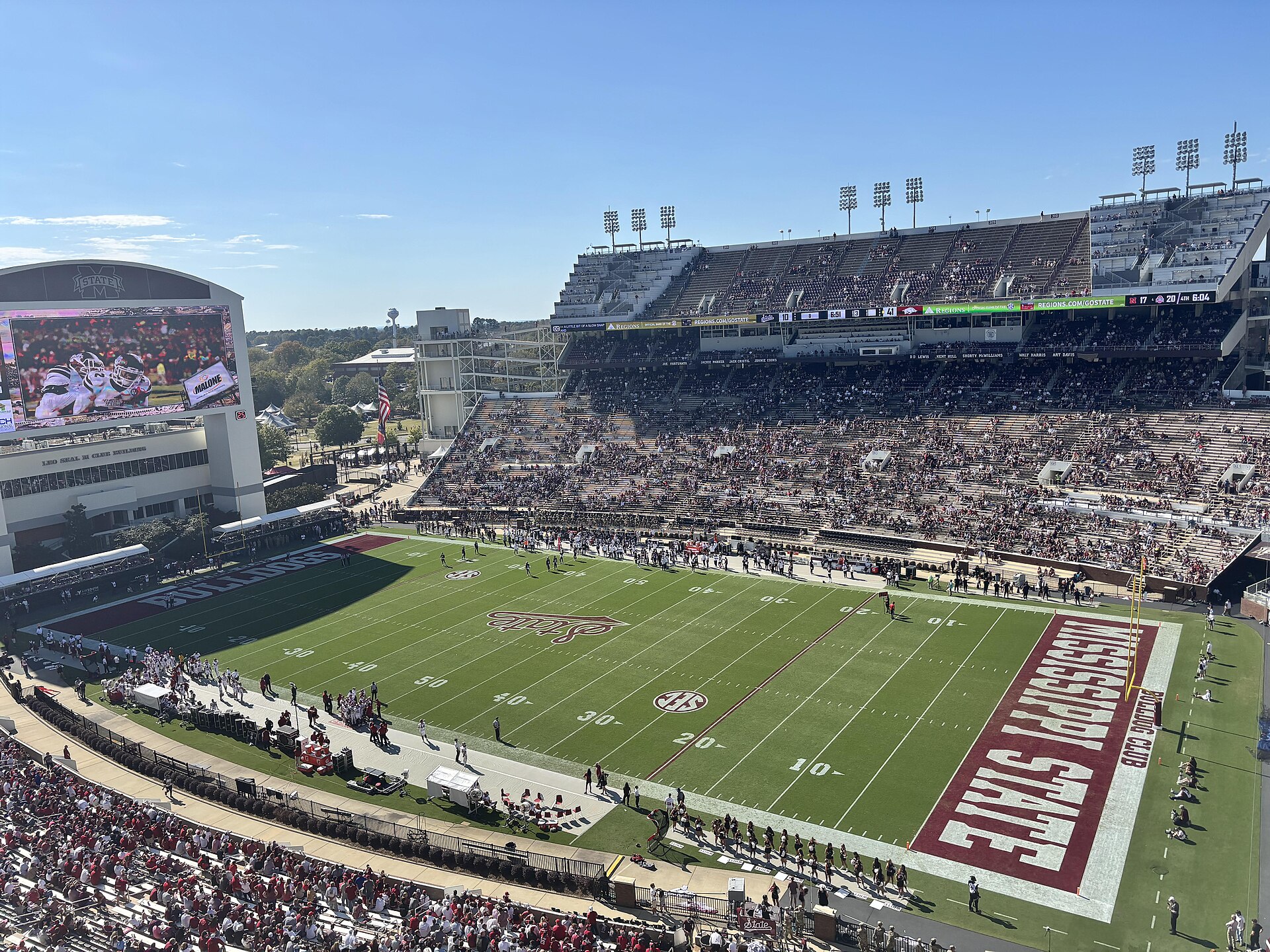
This article was originally published by Mississippi Today on January 19, 2026 and is republished here under a Creative Commons license.
Editor’s note: The following is part of a series examining how the success of the Ole Miss football team could provide some solutions to Mississippi’s brain drain.
College football fans in Mississippi will be talking about the 2025-26 season for a long time, no matter what team they support. Ole Miss’s record-setting 13-2 season came to an end in the semifinals of the College Football Playoff. In a state where potential has historically outstripped performance, the Rebels accomplished what few imagined was possible at the beginning of the season – if ever.
The first playoff appearance for a team from Mississippi. The most wins in a season. The highest final regular season ranking since 1962. And – one can only assume – the most Trinidad and Tobago flags ever sold outside of the Caribbean.
But this season will also be remembered for the topic that has dominated conversation for months among fans and non-fans alike: Mississippi’s brain drain. Two days after the Egg Bowl win against rival Mississippi State, Ole Miss coach Lane Kiffin left Mississippi to take the head job at LSU. Despite six years of tweeting #ComeToTheSip, Kiffin felt that Baton Rouge, Louisiana, offered him more opportunity and prestige than Oxford, Mississippi. Nobody has ever departed the state with so much sound and fury, but plenty before him have moved away for similar reasons.
In the past 12 years, Mississippi has lost more people to other states than the 68,251 who filled Vaught-Hemingway Stadium for the first-round playoff game against Tulane.
Kiffin’s departure dramatized the relationship that has always existed between college football and the brain drain. The state’s first intercollegiate game was played in 1893, around the time that Mississippi began losing population to other states. Since that time, Mississippi’s migration history includes long stretches of losing years, punctuated by a few brief periods of success – similar to the records of Mississippi’s major football programs.
Like the brain drain, college football is a prism for a place’s people, culture and economy. It is a national sport built on local pride, and its symbols and traditions are expressions of communal identity. Cowbells, the Grove, the Sonic Boom and the Fighting Okra encapsulate Mississippi culture as well as whole books written on the subject. But beneath the pageantry, college football boils down to a multibillion-dollar competition for talent. The best teams at the end of the season are almost always the teams that recruited the most talent before the season.
Mississippi excels at producing talent, not recruiting it
You’ll find Mississippians in the top ranks of nearly every profession, but most had to leave the state to get there. Football is the clearest example, in part because it affords us the most complete data.
Mississippi produces football talent at a higher rate than any state in the country. Mississippi ranks first per capita in professional football players all-time, active NFL players, Hall of Famers and professional games played.
By default, every professional football player who grew up in Mississippi left the state for their career. The outmigration of NFL players mirrors the brain drain in other fields. In both cases, Mississippi’s universities are often the launchpad for out-of-state job opportunities.
A college education is hardly the only marker of talent, but it is the sharpest dividing line between who stays in Mississippi and who leaves. Almost half of Mississippi natives move away after earning a bachelor’s degree, compared to only 30% of Mississippians without a four-year degree. University graduates account for all of the net outmigration from Mississippi since 2010.
Nevertheless, Mississippians are only slightly more likely to leave their home state than other Southerners. What separates Mississippi from nearby states is the ability to recruit newcomers to replace them. For every 100 people born in the average Southern state, 28 move away while 59 move in. Mississippi loses 36 but gains only 26.
College students are the primary exception. The state’s universities are the best recruiters of talent to the state – in part because of the national exposure from their college football teams. Approximately 4,500 more college students move to Mississippi each year than move away, the 15th-highest rate of net in-migration in the country. In total, about 38% of the enrollment at Mississippi’s eight public universities has come from outside the state.
Student-athletes enroll at Mississippi’s universities for the same reasons as other students: because they offer quality professional development, vibrant social atmospheres and competitive financial packages. Their recruiting success proves that Mississippi is capable of attracting talent from anywhere – as long as it can match the opportunities that exist in other places.
The brain drain occurs because the opportunities in Mississippi dry up as soon as students graduate. The state ranks last in the share of jobs that require a bachelor’s degree or more. The cost of living is low, but the pay is even lower: college grads take home 10% less in Mississippi than in other Southeastern states even after accounting for price differences. As a result, approximately 95% of out-of-state students leave within five years of graduation, to go along with the nearly half of Mississippi natives.
A changing landscape is creating unlikely winners
Only six schools have won national championships in the playoff era. The final four contenders this year were Indiana, Oregon, Miami and Ole Miss. None had won a recent national championship. The common thread among the four semifinalists is that they have aggressively adapted to the changing recruiting landscape.
Broader societal and economic changes in wake of the pandemic have also shifted the migration of talent among the general population. Many of the largest and wealthiest cities began losing residents in 2020 as knowledge workers took advantage of their newfound ability to work remotely. Housing costs had been growing for decades in the nation’s top talent hubs, and COVID-era inflation brought affordability to a breaking point.
In response, young professionals have flocked to smaller cities that offer many of the same urban amenities at a fraction of the price. As in college football, the established hierarchy remains intact, but with more potential for upward mobility. Talent still tends to flow in the direction of the cities with the biggest economies and highest-paid jobs, but the changes since 2020 have created opportunities to redirect more talent to places that previous generations had left behind.
Ole Miss built one of the nation’s best football teams because it figured out how to use the changing landscape to its advantage. As a state, Mississippi has not yet followed suit.
Jake McGraw leads the Rethink Mississippi initiative at Working Together Mississippi, a nonpartisan civic engagement organization of nonprofits and religious institutions across the state. He began researching and writing about the brain drain when he moved back to Mississippi more than a decade ago. A native of Oxford, he studied public policy and economics at the University of Mississippi and economic history at Oxford University.
Do something about it
Explore the brain drain data · Take the 5-minute survey · See what you can do · Donate — gifts are processed securely by Working Together Mississippi, our parent 501(c)(3).
Header photo: PCN02WPS via Wikimedia Commons, CC BY-SA 4.0